Zum Hauptinhalt springen
Support
0
Kontaktieren Sie uns
English
Nederlands
Español
Dedicated ServersFlexible VPSCloud-TechnologieColocationHerausforderungen in der ITSektorenNachrichten und Blogbeitrage
Cloud Compute

Mit Cloud Compute haben Sie jederzeit und überall Zugriff auf ein Portal, über das Sie Ihre gesamte IT-Umgebung konfigurieren können – egal wo auf der Welt Sie sich befinden.

Cloud-Speicher

Zuverlässiger Zugriff auf Ihre Dateien, Infrastruktur und Anwendungen zu jeder Zeit – ganz ohne Unterbrechungen oder Verzögerungen. Bei Worldstream bieten wir eine Vielzahl von Speicherlösungen an.

Flexible cloud icon
Flexible Cloud
Private cloud icon
Private Cloud
Bare metal icon
Bare Metal Compute
Hollow cube icon
Objektspeicher
Hollow cube icon
Dateiablage
Block storage icon
Blockspeicher
Backup storage icon
Sicherungsspeicher
Brauchen Sie Unterstützung?

Mit erfahrenen Technikern und einer durchschnittlichen Reaktionszeit von 7 Minuten erhalten Sie innerhalb kürzester Zeit eine solide technische Supportlösung.

Support
Dedicated Server

Wählen Sie jetzt Ihren Dedicated Server. Individuelle oder Instant Delivery. Leistungsstarke Server, die perfekt zu Ihrem Anwendungsfall passen.

Use Cases

Ganz gleich, welcher Use Case – wir helfen Ihnen, die ideale Lösung zu finden.

Deal servers icon
Deals
AMD servers icon
AMD-Prozessoren
AI servers icon
Intel-Prozessoren
Hollow cube icon
Virtualisierung, Containerisierung & Orchestrierung
Hollow cube icon
Websites & Applications
Hollow cube icon
Gaming & Streaming Infrastruktur
Brauchen Sie Unterstützung?

Mit erfahrenen Technikern und einer durchschnittlichen Reaktionszeit von 7 Minuten erhalten Sie innerhalb kürzester Zeit eine solide technische Supportlösung.

Support
Flexible VPS

Cloud-Server ab 5,19 € pro Monat, Pay-per-Use und in Minuten live.

Flexible VPS Add-ons

Erweitern Sie Ihren VPS. Ein Load Balancer verteilt Traffic auf mehrere VPS.

Hollow cube icon
Standard
AMD servers icon
Performance
Hollow cube icon
Load Balancer
Brauchen Sie Unterstützung?

Mit erfahrenen Technikern und einer durchschnittlichen Reaktionszeit von 7 Minuten erhalten Sie innerhalb kürzester Zeit eine solide technische Supportlösung.

Support
Smartes Outsourcing

Bestimmte IT-Lösungen generieren Mehrwert, andere erfüllen eher eine unterstützende Funktion. Denken Sie beim Outsourcing daran.

Kosteneffizienz

IT-Komplettpakete mögen erstmal wie eine sichere Option erscheinen, doch wenn man sich die Kosten genau anschaut, sind andere Lösungen oft sinnvoller.

IT-Flexibilität und Kontrolle

Outsourcing heißt nicht, dass man die Kontrolle verliert; man bekommt sogar mehr Flexibilität und Kontrolle.

Cloud-Repatriierung

Die Cloud ist kein Endziel: Sie sollten Ihre Cloud-Umgebung kontinuierlich prüfen und an die sich ändernden Anforderungen anpassen.

Finanzdienstleistungen
Logistik und Transport
Einzelhandel und E-commerce
Medien und Unterhaltung
Technik und Softwareentwicklung
Sicherheit
Managed Service Provider
Brauchen Sie Unterstützung?

Mit erfahrenen Technikern und einer durchschnittlichen Reaktionszeit von 7 Minuten erhalten Sie innerhalb kürzester Zeit eine solide technische Supportlösung.

Chatten Sie mit unsKontaktieren Sie uns
Über WorldstreamÜber die TechnologieKundenfälleWissensdatenbank
Über unsLernen Sie unser Team kennenJobsWerden Sie WiederverkäuferZertifizierungenUnsere RechenzentrenUnser NetzwerkDDoS-SchutzAMD EPYC-ServerTechnologiepartnerBetriebssystemeAlle KundenfälleEasyTerraDutch Drone CompanyPerfGridArtikelFAQNachrichten und BlogbeiträgeProdukte und Services
Kontaktieren Sie uns

Rufen Sie an unter +31 (0) 174 – 712 117 Industriestraat 53, Naaldwijk

Kontaktieren Sie uns
Worldstream Portal
English
Nederlands
Español
0
Dedicated ServersFlexible VPSCloud-TechnologieColocationHerausforderungen in der ITSektorenNachrichten und BlogbeitrageÜber WorldstreamÜber die TechnologieKundenfälleWissensdatenbankMy Worldstream
Contact
Support
EnglishNederlandsEspañol
  1. HomeHome
  2. Knowledge Base
  3. Networking
  4. Load Balancer listeners: ports, TLS, and routing

Load Balancer listeners: ports, TLS, and routing

Gilt für Load BalancerZielgruppe All customersZuletzt geprüft October 2026Status New

Kort antwoord

A listener is the public IP, port, and protocol that receives traffic. Add one on the load balancer’s Listeners tab after the pool has at least one real server. HTTPS needs a hostname whose DNS already points at that public IP; Let’s Encrypt can issue the certificate, or you upload your own PEM.

Auf dieser Seite
  • Public IPs
  • Protocol and port
  • HTTPS certificates
  • Who may connect, limits, and routes
  • After you add a listener

A listener is the front door: public address, port, and protocol. The pool behind it is where connections go. Create the pool and at least one real server first. The empty Listeners tab says the same: pool → real server → listener.

Open the load balancer, then the Listeners tab, then Add listener.

Public IPs

The Public IPs field picks which firewall addresses this listener binds.

  • IPv4 is the usual visitor address.
  • IPv6 is optional on the same port. Members behind the listener stay IPv4.
  • Only addresses in READY state can be selected. Add IPv4 and Add IPv6 allocate a new address on the same firewall if you still have quota. IPv6 does not count against the IPv4 limit; IPv4 may add a monthly charge, which the confirm dialog shows when pricing is available.

You cannot change the public address or protocol after create. Delete the listener and add a new one if you need a different port or protocol.

Protocol and port

ProtocolUse it when
HTTPSWebsites and APIs that should terminate TLS on the load balancer (HTTP/2 is offered to clients)
HTTPPlain web traffic, or when you want port 80 yourself instead of the HTTPS redirect
TCPPass traffic through unchanged, including TLS that the real server terminates itself

The hint in the form is the same: HTTPS for websites, HTTP for plain web traffic, TCP to pass traffic through unchanged.

HTTPS also needs a hostname whose DNS already points at this public IP. If you also bound IPv6, the hostname needs a matching AAAA.

HTTPS certificates

On Add listener, with protocol HTTPS:

1

Type the hostname

For example app.example.com. Portal checks that DNS already points at the VIP.

2

Choose a certificate

Pick Let's Encrypt or Upload your own.

3

HTTP to HTTPS redirect

Leave Redirect HTTP to HTTPS on unless you need a separate HTTP listener on port 80.

Let's Encrypt uses HTTP-01. The hostname must resolve to the listener IP before you create the listener. Worldstream does not write DNS records for you.

Upload your own takes a Certificate (PEM) and Private key (PEM). Extra names in the certificate are included only when they also resolve to this IP.

After create, open the listener and use the Certificate tab to add names or re-issue. Account-wide Let's Encrypt contact email lives on the load balancer Settings tab (Let's Encrypt contact / Override email). If you leave it empty, Portal uses the account owner email.

Note: Turning the HTTP redirect off still opens port 80 temporarily during certificate request and renewal. That port then answers only /.well-known/acme-challenge/, not your site.

An explicit HTTP listener on port 80 replaces that redirect. The ACME challenge path stays.
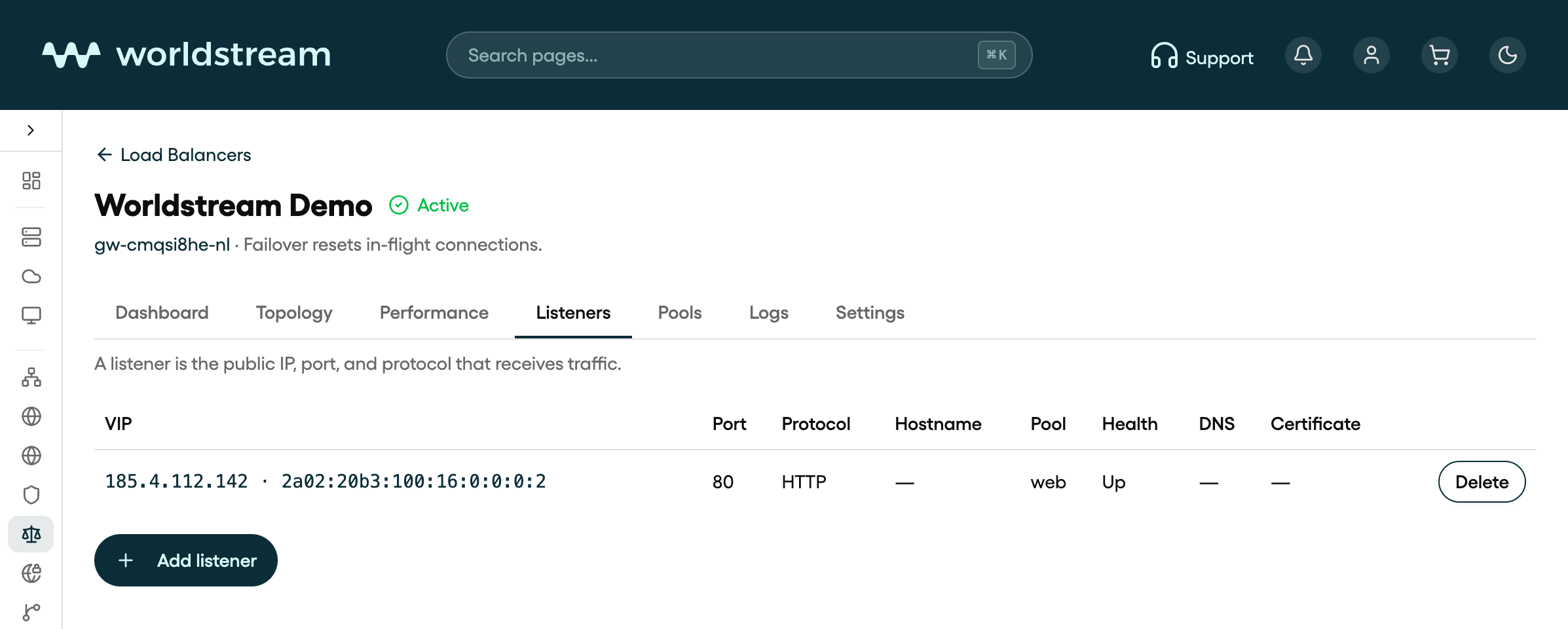
Listeners tab in Portal: HTTP listener on port 80 for Worldstream Demo, pool web, health Up
Listeners tab on the Worldstream Demo load balancer in Portal, October 2026. Your own names, IPs, and counts will differ.

Who may connect, limits, and routes

Open a listener from the table to edit it. Tabs are General, Certificate (HTTPS only), Capacity, and Routes (HTTP and HTTPS).

General

  • Default pool — where new connections go when no host or path rule matches.
  • Who may connect — source networks, one CIDR per line. Empty is the public internet. IPv4 and IPv6 CIDRs are both valid. A v4-only list denies IPv6, and the other way around.

Capacity (optional on create under Limits)

  • Max concurrent connections — leave empty to use the plan limit.
  • HTTP rate limit — requests per 10 seconds from one client IP, HTTP and HTTPS only. Empty means no limit.
  • Timeouts: Client timeout (1–3600 s), Server timeout (1–3600 s), Connect timeout (1–120 s).

Routes (HTTP and HTTPS)

Send some hostnames or URL prefixes to another pool. First matching rule wins. Everything else uses the default pool. Fields are Host (optional, for example api.example.com), Path prefix (optional, for example /api/v1.json), and Send to pool, then Add rule.

TCP listeners have no Routes tab. Use TCP when you want TLS passthrough to the real servers instead of terminating TLS on the load balancer.

After you add a listener

Status on the load balancer goes to Syncing while the change is applied, then Active. The listener table shows VIP, port, protocol, hostname, pool, health, DNS (Points at VIP or a mismatch), and certificate state.

Delete a listener from the table. Traffic on that VIP and port stops.

Verwandte Artikel

  • Load Balancer in Portal: what it is and how to create one
  • Load Balancer pools: real servers and health checks
  • How SSL/TLS certificates work
  • Firewall basics in Portal
War dieser Artikel hilfreich?

Solide IT. Keine Überraschungen

Sparringspartner für IT-Reife
Wir räumen die Hindernisse aus dem Weg, damit Sie freie Bahn haben
Vorhersehbare und transparente Kosten

Kontakt

  • Industriestraat 53, Naaldwijk
Kontaktieren Sie uns
Worldstream Portal (opens in a new tab)
  • Zahlungsmöglichkeiten
  • Missbrauch
  • Ressourcen für Entwickler
  • Network Operations Center
  • Über uns
  • Lernen Sie unser Team kennen
  • Jobs
  • Werden Sie Wiederverkäufer
  • Zertifizierungen
  • Unsere Rechenzentren
  • Unser Netzwerk
  • DDoS-Schutz
  • AMD EPYC-Server
  • Technologiepartner
  • Betriebssysteme
  • Übersicht
  • FAQ
  • Kundenfälle
  • Nachrichten und Blogbeiträge
  • Use Cases
English
Nederlands
Español
English
Nederlands
Español
  • Rechtliches
  • Transparenzhinweis