AI Inference on Bare Metal: Why Smart Teams Are Ditching Cloud GPUs in 2026
Cloud GPU pricing was designed for a different era
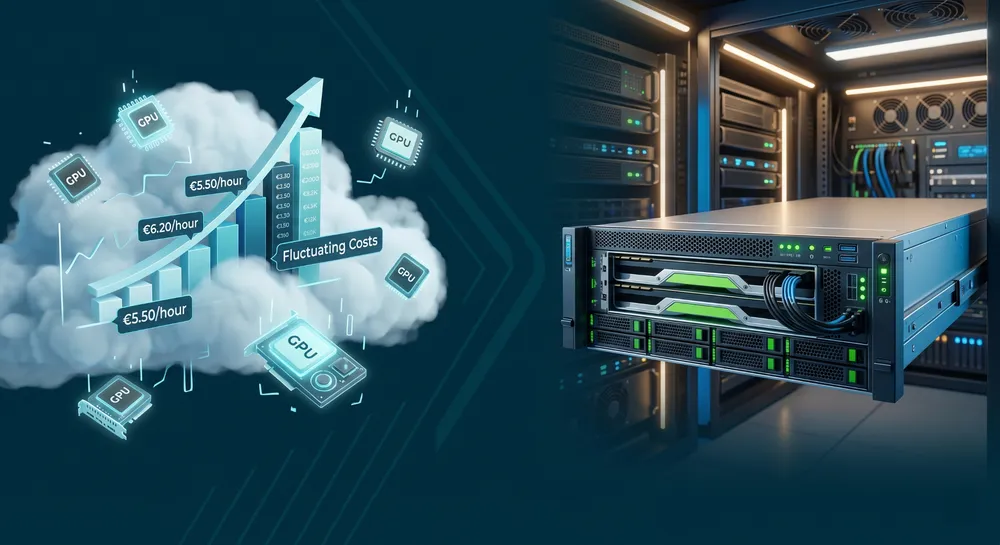
When cloud providers first offered GPU instances, the value proposition was clear: rent expensive hardware by the hour, avoid the capital expenditure, scale up and down as needed. For training runs that take days or weeks and then stop, this model makes sense. For inference workloads that run 24/7, it is one of the most expensive decisions an AI team can make.
The GPU cloud market in 2026 reveals a pricing gap that is difficult to justify. A single H100 GPU instance on a major hyperscaler costs approximately €11–12 per hour. Specialized GPU cloud providers offer the same hardware at €2–3 per hour — a 4–6x difference for identical silicon. And bare metal GPU servers, where you rent the physical machine outright, push costs lower still.
The question every AI team should be asking is not “which cloud provider has the best GPU pricing?” but “should we be using cloud GPUs for this workload at all?”
The hypervisor tax: what virtualization costs you
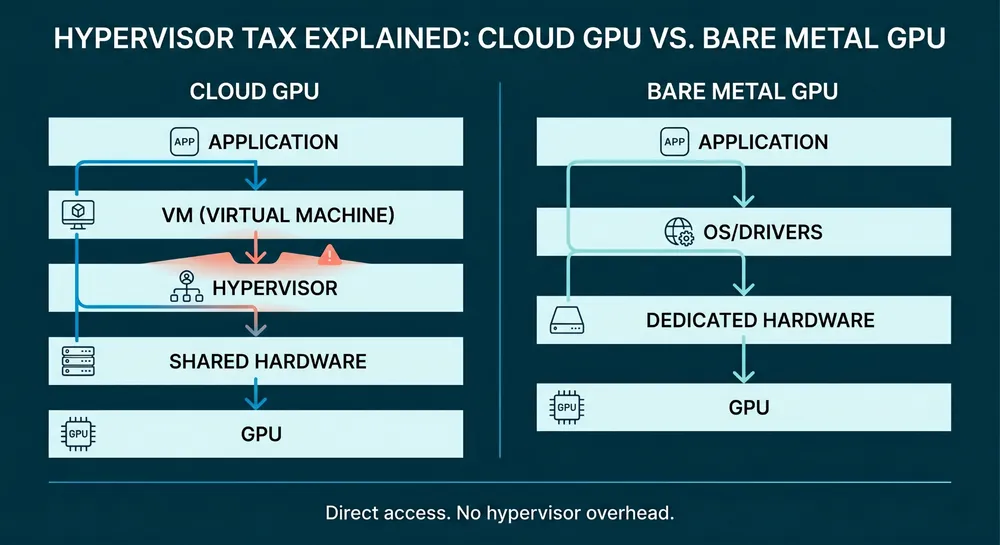
When you rent a cloud GPU instance, you are not getting the full hardware. A virtualization layer — the hypervisor — sits between your code and the physical GPU. This layer exists so the cloud provider can slice hardware across multiple customers, manage resources, and provide the flexibility that makes cloud computing work.
The cost of that abstraction is real. Industry benchmarks consistently show that virtualized GPU environments lose 10–15% of raw performance compared to bare metal. For AI models that require maxing out PCIe Gen 5 data transfers to feed GPUs, the hypervisor acts as a measurable bottleneck.
On bare metal, you get:
- Full NVLink bandwidth for multi-GPU communication — critical for large model inference
- 35 TB/s memory bandwidth without virtualization overhead consuming a portion
- Zero hypervisor overhead on CPU-GPU data paths
- Direct hardware access for custom CUDA kernels, driver versions, and low-level optimizations
The performance gap is not theoretical. Benchmarks show a 30%+ difference between virtualized and bare metal GPU workloads for inference tasks. That means your bare metal server is not only cheaper per hour — it also processes more requests per second, compounding the cost advantage.
The cost comparison: cloud vs. bare metal for sustained inference
Let’s do the math on a common configuration — a 4-GPU H100 setup running inference around the clock.
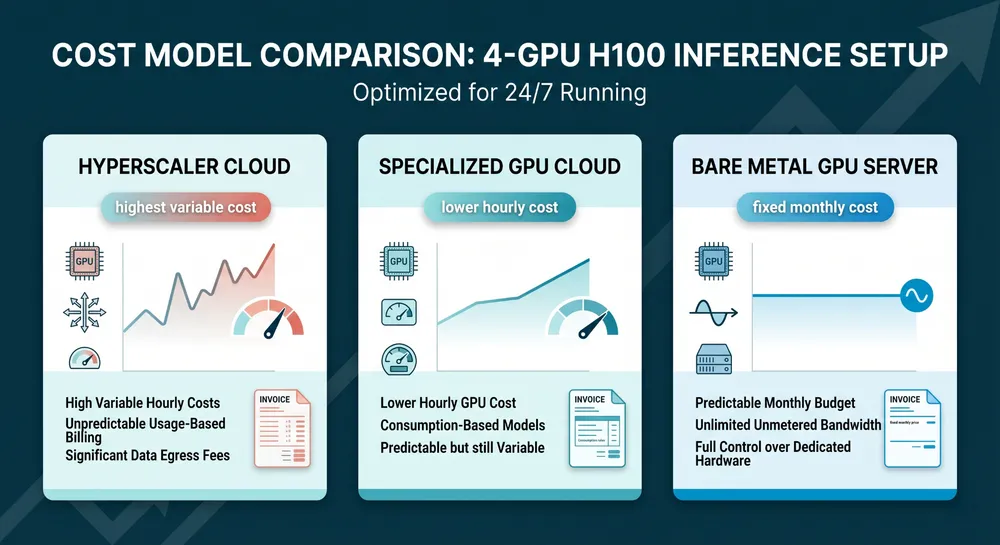
Hyperscaler cloud (on-demand):
At approximately €11–12 per GPU per hour, a 4-GPU instance costs roughly €44–48 per hour. That is €32,000–35,000 per month, or approximately €384,000–420,000 per year. Reserved instances reduce this, but come with long-term commitments and limited flexibility. Add egress fees (20–40% on top for data-heavy AI workloads), storage premiums, and monitoring costs, and the true annual spend pushes well above €450,000.
Specialized GPU cloud:
At €2–3 per GPU per hour, the same 4-GPU configuration costs €8–12 per hour — roughly €5,800–8,700 per month. A significant improvement, but still consumption-based with variable costs.
Bare metal GPU server:
A dedicated bare metal server with comparable GPU hardware comes at a fixed monthly cost. No per-hour billing. No egress fees on unmetered bandwidth. No hypervisor tax on performance. The break-even point against cloud GPU pricing is typically reached within 4–8 weeks of operation. After that, every month represents pure savings.
For a team processing 10 million tokens per day, the difference between hyperscaler GPU pricing and bare metal translates to €1,000–1,500 in monthly savings — and that is just the direct compute cost, not counting the performance advantage that lets you serve more requests on the same hardware.
When cloud GPUs still make sense
This is not a blanket recommendation against cloud GPUs. Like most infrastructure decisions, the right choice depends on your workload pattern.
Cloud GPUs are the right call when:
- You are running training jobs that take days or weeks, then stop completely
- Your GPU needs are genuinely unpredictable — bursty workloads with long idle periods
- You are prototyping and do not yet know your long-term compute requirements
- You need access to cutting-edge hardware (H200, B100) before it is available in dedicated hosting
Bare metal GPUs are the right call when:
- You are running inference workloads 24/7 or near-continuously
- Your GPU utilization is consistently above 40–50%
- You need maximum performance without virtualization overhead
- You want predictable monthly costs instead of variable billing
- Data privacy requirements make it preferable to keep AI processing on dedicated, single-tenant hardware
The pattern mirrors the broader cloud-vs-bare-metal calculus: if your workload is steady and predictable, fixed-cost infrastructure nearly always wins on price and performance.
The self-hosting angle: private AI for zero API cost
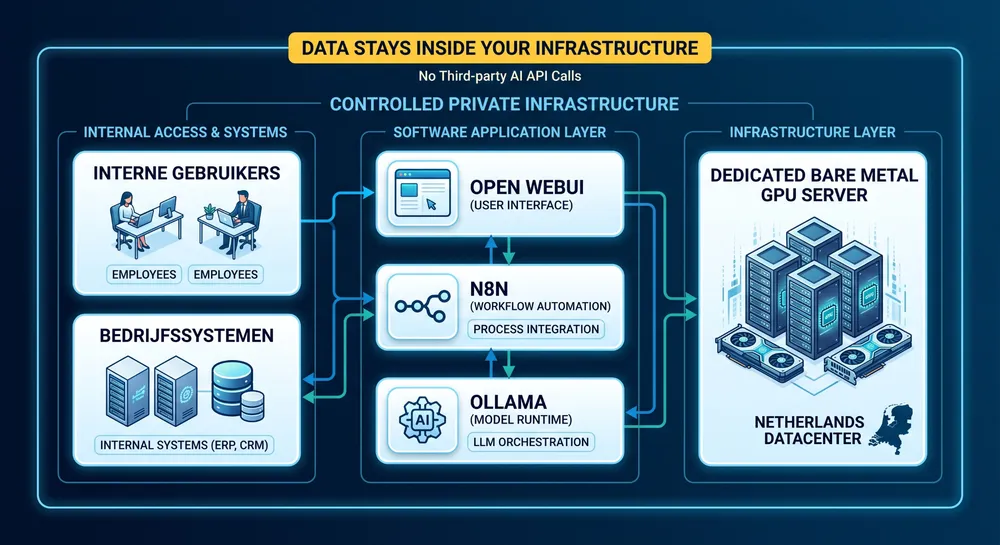
There is a parallel trend worth noting. The self-hosting community has embraced local AI inference with remarkable enthusiasm. Tools like Ollama make running large language models on your own hardware trivially easy. Combined with interfaces like Open WebUI, teams are building private AI assistants that cost exactly zero in API fees after the initial hardware investment.
For organizations concerned about data privacy — sending confidential documents, code, or customer data to third-party AI APIs — running inference on dedicated hardware solves the problem entirely. The model runs on your server. The data never leaves your infrastructure. There are no API rate limits, no usage caps, and no third-party data processing agreements to negotiate.
The combination of n8n (workflow automation) with Ollama on a dedicated server has become a popular stack in 2026 for teams building private AI-powered automations — document processing, code review, customer support triage, internal knowledge search — all running on infrastructure they control.
What to look for in a bare metal GPU server
Not all GPU servers are equal. If you are evaluating bare metal GPU hosting for AI inference, here is what to assess:
GPU generation and memory. For inference, VRAM is often the bottleneck. A model that fits entirely in GPU memory runs dramatically faster than one that needs to swap to system RAM. Check that the GPU has enough VRAM for your target models. For large language models in 2026, 80 GB per GPU (H100) is the baseline for production inference of models with 70B+ parameters.
Inter-GPU connectivity. If you are running multi-GPU inference (tensor parallelism across GPUs), NVLink bandwidth matters enormously. Cloud VMs sometimes limit or virtualize NVLink access. Bare metal gives you the full interconnect.
Bandwidth. AI inference APIs serve requests over the network. If you are running a high-throughput inference endpoint, network bandwidth matters. Look for unmetered 1 Gbps or 10 Gbps connectivity so that network costs do not scale with usage.
Storage performance. Model loading times depend on storage speed. NVMe drives are the minimum for production inference. Large models (100+ GB) need fast sequential read speeds to load in reasonable time.
Pricing transparency. The whole point of moving to bare metal is cost predictability. Look for flat monthly pricing that includes bandwidth, power, and standard support. If the pricing page requires a calculator to understand, you are solving the wrong problem.
Data location and privacy. For European organizations processing personal data through AI models, where the hardware sits and who has legal access to it matters. European-owned infrastructure under EU jurisdiction avoids the legal complexities of the CLOUD Act and simplifies GDPR compliance.
The hidden costs that make cloud GPUs even more expensive
The hourly GPU rate is rarely the full picture. Cloud GPU costs come with several multipliers that are easy to overlook:
- Egress fees. AI inference APIs receive requests and send responses. For vision models processing images or multimodal models with large outputs, data transfer costs add 20–40% to the base compute bill.
- Storage costs. Model weights need to be stored somewhere. High-performance cloud storage is billed separately, and large models (50–200 GB per model) add up quickly when you maintain multiple model versions.
- Idle costs. GPU instances are expensive even when idle. If your inference traffic has quiet periods but you cannot afford cold-start latency, you are paying full price for a GPU doing nothing.
- Monitoring and observability. Cloud monitoring services for GPU metrics, logging, and alerting are billed separately and scale with the volume of data you ingest.
On a bare metal GPU server with flat-rate pricing and unmetered bandwidth, these costs either disappear (egress, monitoring) or are included in the fixed monthly rate (storage, power). The total cost of ownership difference is often larger than the GPU hourly rate alone suggests.
Where Worldstream fits
Worldstream operates its own data center in the Netherlands, providing GPU-capable dedicated servers with flat-rate monthly pricing and unmetered bandwidth. For teams running sustained AI inference workloads, this means predictable costs on single-tenant hardware with full GPU performance — no hypervisor tax, no egress fees, no billing surprises.
The infrastructure sits under EU jurisdiction, which matters for organizations processing sensitive data through AI models. No CLOUD Act exposure. No data leaving European borders. The same data protection standards that apply to your production databases apply to your AI inference stack.
Whether you are running a customer-facing inference API, an internal AI assistant with Ollama, or a private automation pipeline with n8n, the economics point the same direction: if the GPU is running around the clock, bare metal pays for itself in weeks, not months.
The takeaway
Cloud GPU pricing was designed for a world where GPU workloads were bursty and unpredictable. AI inference in 2026 is the opposite — sustained, steady, and always on. Running these workloads on consumption-based cloud pricing is like leaving the taxi meter running while you sleep. Bare metal GPU servers offer 40–85% lower costs, 30%+ better performance, and the predictability that lets you budget with confidence. The break-even is measured in weeks. The savings compound from there.