AMD EPYC 7543 dedicated server: 32-core power for growing workloads
Knowledge blog
Some workloads do not stay small.
What starts as one application can later become a mix of virtual machines, databases, customer environments, test environments, backup tasks, and monitoring. Technically, it still works. But it often stops being clear and manageable.
At that point, you do not need a server that mainly looks impressive on paper.
You need a dedicated platform with enough capacity to support growing workloads properly. With enough CPU, ample memory, suitable storage, and network capacity that can grow with your usage.
That is where the Dell PowerEdge R6515 with AMD EPYC 7543 fits well.
This server delivers 32 cores, 64 threads, and a 2.80 GHz clock speed. At Worldstream, you can configure it with 64 GB to 1024 GB REG ECC DDR4 RAM, multiple storage options, and guaranteed bandwidth profiles.
In short: this is not a small all-round server. And it is not a server you choose only for extreme CPU workloads.
This is a strong 32-core dedicated server for virtualization, consolidation, hosting platforms, databases, and other workloads that have grown beyond the basics.
What kind of server is this?
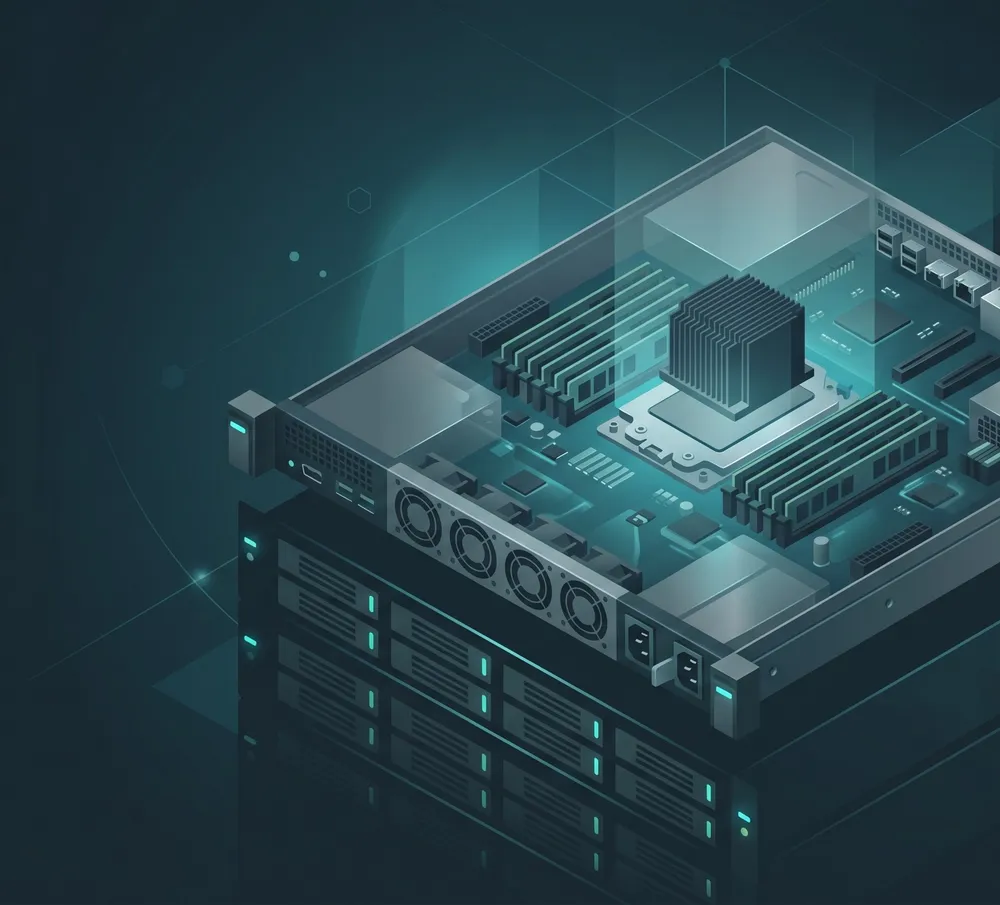
The Dell PowerEdge R6515 is a compact 1U rack server based on a single-socket AMD EPYC platform. Dell specifies this system with support for one AMD EPYC 7002 or 7003 processor, 16 DIMM slots, and redundant power supplies.
In this configuration, the server runs on an AMD EPYC 7543. That processor offers 32 cores and 64 threads. This makes the server especially suitable for environments where multiple processes run at the same time. Think of virtualization, container platforms, databases, application servers, and customer environments.
The strength is not only in the CPU.
Memory is just as important here. The configurator offers choices of 64 GB, 128 GB, 256 GB, 512 GB, and 1024 GB REG ECC DDR4 RAM. That makes this server interesting for workloads where RAM quickly becomes the limiting factor. For example, virtualization, caching, databases, or applications that process large amounts of data in memory.
Storage is flexible as well. You can configure this server with up to 4x SATA HDD, SSD, or Enterprise SSD, plus 1x PCIe NVMe SSD. This allows you to choose what makes sense for your workload. Not every environment has the same storage needs. A database requires something different from a hosting platform or a server for internal tooling.
On the network side, the configuration starts with 1 Gbit/s and 50 TB traffic. Heavier options are available, such as 10 Gbit/s with 100 TB, 10 Gbit/s with 500 TB, and 1 Gbit/s unmetered. Worldstream states that these speeds are guaranteed and full-duplex.
When is this server the right choice?
The AMD EPYC 7543 is especially interesting when your workload is no longer small, but also does not require maximum CPU capacity at any cost.
This is the server for environments that grow in width.
More virtual machines. More customer environments. More applications. More memory demand. More processes that need to run at the same time.
That is why this server is a good fit for organizations that want to consolidate their infrastructure. Not by blindly putting everything on one machine, but by deliberately bringing workloads together on a dedicated platform with enough CPU, memory, and storage capacity.
That makes the EPYC 7543 a rational choice for teams that need more room, but want to keep their environment manageable.
You do not choose this server because it is the biggest on paper.
You choose it because 32 cores, 64 threads, and generous RAM options often provide exactly enough room to scale seriously without configuring more hardware than you need.
That is the strength of this server: a lot of capacity, while still staying manageable.
Which use cases is this server suitable for?
Virtualization and private cloud
This is probably the most logical use case.
With 32 cores, 64 threads, and memory options up to 1024 GB RAM, this server is suitable as a virtualization host or private cloud node. Think of environments where multiple virtual machines run side by side, each with its own resources.
The value is in control.
You decide how much CPU, RAM, and storage each environment receives. You can logically separate customer environments, applications, test environments, and management tools. And you do not immediately need to manage multiple smaller servers when one powerful node is a better fit.
Important note: one server is not a complete high availability architecture. For that, you need multiple nodes, solid backups, replication, and failover.
But as a powerful 32-core building block, this server is a strong foundation.
Consolidation of smaller servers
Many IT environments grow messy.
A separate application server. A separate database. A test environment that was supposed to be temporary. A customer environment that keeps running anyway. After a while, you end up with a collection of servers that works technically, but is hard to manage.
The AMD EPYC 7543 is interesting when you want to reduce that fragmentation.
Not by putting everything on one machine without a plan. That is not consolidation. That is cleanup with risk.
But by deliberately bringing workloads together on a dedicated server with enough room. This gives you more overview, simpler management, and better visibility into where the real load is.
Managed hosting and MSP platforms
For hosting providers and MSPs, this server is a practical choice when customer environments need more room than a light server can provide.
Think of application hosting, hosting panels, monitoring, internal tooling, backup tasks, and separated customer environments.
The configurator supports multiple operating systems, including Ubuntu 24.04, Debian 13, CentOS Stream 9, Debian 12, and Windows Server 2022 Standard. Specific OS requirements apply to cPanel and DirectAdmin. So that choice needs to be aligned with your management stack in advance.
That may sound like a detail. But these are exactly the details that prevent issues later.
Databases and memory-intensive applications
Not every database mainly needs more cores.
The bottleneck is often memory, disk I/O, indexes, query behavior, or application logic. That is why this server is especially interesting for database and data environments that benefit from a combination of CPU capacity, a lot of RAM, and suitable storage.
Think of PostgreSQL, MySQL, Redis, Elasticsearch, caching layers, search platforms, or internal data applications.
For I/O-sensitive workloads, SSD or NVMe makes more sense than standard HDD. The configurator supports this with SATA SSD, Enterprise SSD, and PCIe NVMe options.
Here too, the same applies: if availability is critical, design it separately. This server can be a strong database node. It is not automatically your complete database architecture.
Why this server?
Because it offers a clear balance.
The AMD EPYC 7543 is powerful enough for serious workloads, but it is not automatically the heaviest choice. That makes it interesting for organizations that want to scale up without making their infrastructure unnecessarily large or complex.
The combination of 32 cores, 64 threads, generous memory options, and configurable storage makes this server especially strong for workloads that need CPU, RAM, and storage at the same time. Not one extreme specification. A solid overall setup.
That is often smarter than continuing to stack smaller servers.
And honestly, it is also smarter than choosing the biggest server because it feels better on paper.
Good infrastructure does not start with the heaviest hardware. It starts with the right match for your workload.
Why this server at Worldstream?
With a dedicated server, you should not only look at the processor.
The environment around it determines how well the server works in practice. Think of network capacity, DDoS protection, remote management, support, SLA choices, and clear monthly costs.
With this configuration, 20 Gbit/s DDoS protection is included, with the option to upgrade to 100 Gbit/s. Remote management through My Worldstream is included, including iDRAC, remote reboot, and reinstallations. The configurator also states that this server is delivered the next business day.
The SLA choices are concrete as well. Bronze SLA is included with best-effort response and best-effort hardware replacement. Silver SLA+ offers guaranteed response within 60 minutes and hardware replacement within 4 hours. Gold SLA+ offers guaranteed response within 15 minutes and hardware replacement within 2 hours.
That fits how you want to work with dedicated infrastructure: clear, predictable, and without unnecessary layers in between.
No vague promise that one server solves everything.
A powerful dedicated foundation that you can configure exactly for what you need.
Configure the Dell PowerEdge R6515 with AMD EPYC 7543
Looking for a dedicated server for virtualization, private cloud, managed hosting, databases, or consolidation of growing workloads?
Then the Dell PowerEdge R6515 with AMD EPYC 7543 is a strong option.
Not the lightest server. Not the heaviest choice.
A configurable 32-core dedicated server for teams that need more room and want to keep their infrastructure clear and manageable.