DDR5 Memory Prices Surged 307%. Here Is What That Means for Your Infrastructure Budget.

News
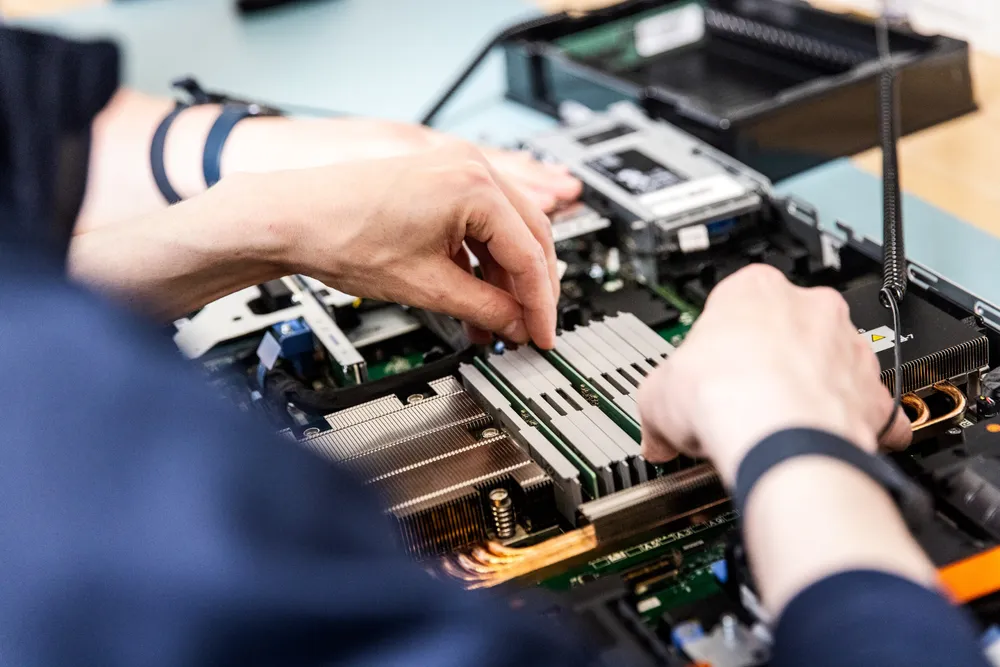
Between October and December 2025, DDR5 memory prices increased by 307 percent. Not a typo. Not annualized. A threefold price increase in a single quarter.
If you buy, lease, or rent servers, this directly affects what you will pay in the coming months. Server-grade DDR5 modules that cost $600 to $800 a year ago now run between $2,000 and $4,000 per module. DDR4 prices climbed 158 percent in the same period. And the cause is not a temporary supply chain hiccup — it is a structural shift in global DRAM demand that is not expected to ease until 2027 at the earliest.
The irony: even if your organization has nothing to do with artificial intelligence, the AI boom is making your infrastructure more expensive.
What Is Driving the Price Surge
The short answer is AI. The longer answer involves semiconductor economics, wafer capacity constraints, and the sheer volume of memory that large language models and AI training infrastructure require.
AI Is Consuming 40% of Global DRAM
AI workloads now consume approximately 40 percent of the world’s DRAM output. Large-scale AI training clusters require enormous quantities of high-bandwidth memory. A single GPU training node can require 192 GB to 384 GB of HBM (High Bandwidth Memory), and these clusters scale to thousands of nodes.
Projects like OpenAI’s Stargate initiative have reportedly secured 900,000 DRAM wafers per month — a staggering commitment of manufacturing capacity. When a single buyer locks up that volume, the remaining supply for everyone else tightens significantly.
The Wafer Displacement Effect
AI memory (HBM) consumes roughly three times the wafer capacity per gigabyte compared to standard DDR5. Semiconductor fabs are rational businesses — they prioritize the highest-margin products. When AI customers are willing to pay premium prices for HBM, fabs allocate wafer capacity accordingly. The result: less capacity available for conventional server memory, which drives up prices for everyone.
This is not a temporary bottleneck. Building new semiconductor fabrication capacity takes years. The fabs being planned today will not come online until 2028 or 2029. Until then, the DRAM market operates with structurally constrained supply.
The Ripple Effect on Server Pricing
Memory is not an isolated line item. When DRAM prices rise, the entire server ecosystem adjusts. Dell and Lenovo have already confirmed component cost increases to their channel partners. Industry leaders forecast 5 to 10 percent server price increases between April and September 2026, with some configurations — particularly memory-intensive ones — seeing larger jumps.
Cloud providers will absorb some of this cost through their existing margins, but they will also pass a portion through to customers via higher instance prices, reduced free-tier allocations, or new surcharges. History shows that cloud price increases rarely appear as a single line item — they surface as gradual adjustments across instance types, storage tiers, and regional pricing.
Who Feels This Most
Not every infrastructure buyer is equally exposed. The impact depends on your procurement model, your workload profile, and how memory-intensive your applications are.
If You Buy Hardware Outright
Organizations that purchase servers directly face the most immediate impact. A server that cost $8,000 six months ago may now cost $10,000 to $12,000 for the same specifications. Memory-heavy configurations — database servers, in-memory caching clusters, analytics workloads — see the largest cost increases because DDR5 is a proportionally larger share of the total bill of materials.
If You Use Cloud Instances
Cloud providers typically adjust prices with a delay, but the adjustment comes. Memory-optimized instance types (r-series on AWS, E-series on Azure, n2-highmem on GCP) are likely to see the earliest and largest adjustments. If your workload relies heavily on these instance types, budget accordingly.
The hidden risk: reserved instance pricing that seemed like a good deal at the time of purchase may look less favorable when on-demand pricing adjusts upward and your reserved capacity is locked at old specifications. The math of reserved versus on-demand shifts when the baseline moves.
If You Rent Dedicated Servers
Dedicated server providers sit between these two extremes. Providers that own their own data centers and maintain inventory buffers can absorb short-term component cost volatility. But sustained price increases eventually flow through to monthly rates as providers refresh their hardware fleet.
The advantage of the dedicated server model in this environment: your monthly rate is fixed for the duration of your contract. Unlike metered cloud pricing, a dedicated server does not quietly become more expensive. What you signed up for is what you continue to pay. This predictability becomes more valuable when the underlying hardware market is volatile.
What This Means for 2026 Infrastructure Budgets
If you set your infrastructure budget based on 2024 or early 2025 pricing, you may need to revisit those numbers. Here is a practical framework for assessing the impact on your organization:
- Audit your memory footprint. Calculate the total RAM across all your production, staging, and development environments. Distinguish between memory that is actively used and memory that is provisioned but idle. This baseline tells you how exposed you are to DRAM price increases.
- Identify memory-intensive workloads. Databases (especially in-memory databases like Redis or SAP HANA), caching layers, data analytics platforms, and virtualization hosts are the most memory-dependent. These are the workloads where DRAM cost increases have the largest absolute impact.
- Check your contract renewal dates. If you have dedicated server contracts renewing in Q2 or Q3 2026, now is the time to discuss renewal pricing or lock in extended terms at current rates. Waiting until renewal time means negotiating against a rising market.
- Evaluate right-sizing opportunities. When memory costs more, right-sizing becomes more valuable. An application running on a 128 GB server that only uses 40 GB of RAM is wasting significantly more money than it was a year ago. Right-sizing is always good practice, but rising component costs make it urgent.
- Consider your procurement timeline. If you have planned hardware purchases or server deployments for the second half of 2026, moving those decisions forward could save meaningful money. The consensus forecast is that prices will continue to rise through mid-2026 before potentially stabilizing — but not declining — in late 2026.
The Bigger Picture: Why This Is Not Temporary
Previous DRAM price spikes have typically been cyclical — demand surges, supply catches up, prices normalize. This time is different for a structural reason: AI workloads represent a new, sustained demand category that did not exist at significant scale five years ago.
Global data center power demand in Europe alone is projected to grow from 100 TWh to 150 TWh by 2026, driven primarily by AI infrastructure. Modern AI racks demand 50 to 100 kW per rack, compared to 5 to 10 kW for traditional server racks. This is not a temporary spike in demand. It is a permanent expansion of the infrastructure market’s appetite for semiconductor resources.
The practical implication: infrastructure costs are structurally higher than they were two years ago, and the era of steadily declining hardware costs per unit of performance may be pausing. Organizations that plan for flat or declining hardware costs in their long-term forecasts should update those assumptions.
Where Worldstream Fits
Worldstream operates its own data centers and maintains direct relationships with hardware suppliers. This provides two advantages in a rising-cost environment:
First, price stability. Worldstream’s dedicated server pricing is fixed for the contract term. When you sign up for a server at a given monthly rate, that rate does not change because DRAM spot prices moved. You are insulated from the quarterly fluctuations that affect organizations buying hardware on the open market.
Second, infrastructure scale. As a large-scale infrastructure provider, Worldstream procures hardware in volume and can negotiate supply agreements that smaller buyers cannot. This purchasing power translates to pricing that remains competitive even as component costs rise.
For organizations looking to lock in predictable infrastructure costs against a volatile hardware market, a dedicated server with a fixed monthly rate eliminates one significant variable from your budget equation.
The Bottom Line
DDR5 prices have tripled. Server costs are rising. And the AI demand driving these increases is not going away — it is accelerating.
This is not a reason to panic. It is a reason to plan. Audit your memory usage. Right-size where you can. Lock in pricing on workloads that are stable and predictable. And make infrastructure procurement decisions with the understanding that waiting is unlikely to result in lower prices this year.
The organizations that come through this transition well will be the ones that separated the workloads that need flexibility from the ones that need predictability — and matched each to the right infrastructure model.