Dedicated Server Provider. What Matters Most When You Buy Bare Metal in Europe
TL;DR
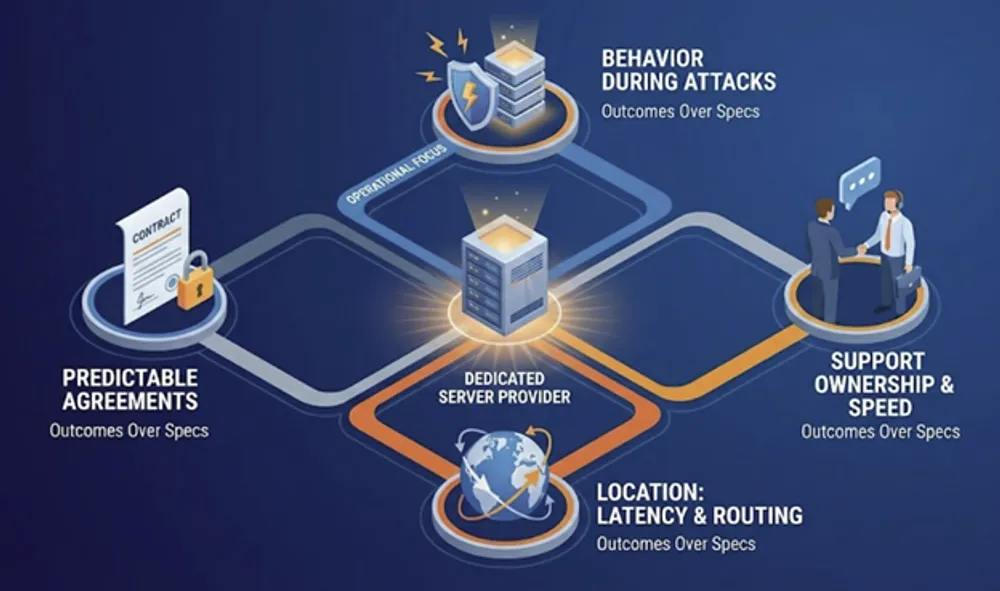
- Most dedicated server failures are operational, not technical.
- If attacks are likely, you are not buying “DDoS protection”. You are buying how the provider behaves during an attack.
- Support quality is response speed plus ownership. Not a label.
- Location is a latency and routing decision. Not a nationality badge.
- Clear terms and predictable billing reduce risk. Surprises are downtime in slow motion.
Most Dedicated Server Failures Are Operational. Here’s How to Choose the Right Provider in Europe.
You can pick a dedicated server in 30 minutes.
CPU. RAM. NVMe. Bandwidth. Price.
It feels productive. It is also the part that rarely hurts you later.
If you run anything that matters, the problems come from the bad days.
A DDoS attack. A disk failure. A routing issue. A ticket that goes quiet while your customers keep calling. A policy decision that takes you offline when you need stability.
So this post is not another spec comparison.
It is a practical guide to choosing a dedicated server provider in Europe based on outcomes, not tables.
Specs are not the hard part
Most serious providers can offer comparable hardware.
The differentiators sit around the hardware:
- Network behavior under stress
- DDoS handling and mitigation capacity
- Support ownership and escalation
- Location, routing, and realistic latency
- Contracts, policies, and billing predictability
If those parts are weak, dedicated servers become “cheap” in the worst way. Cheap upfront. Expensive to operate.
Start with your workload. Your use case decides the priorities
E-commerce and business applications
If your server runs revenue, your priorities are boring and strict.
You need stability, predictable performance during peaks, and fast incident response.
In e-commerce, a one-hour outage is not a technical event. It is a commercial event.
Game servers and hostile traffic
Gaming workloads are different.
Some communities attract targeted attacks. Sometimes just because people can.
Here the deciding factor is simple.
Do you stay reachable during attacks, or do you get removed from the network to protect everyone else.
That is why “anti-DDoS dedicated servers Europe” is high intent. People are not hunting for a feature. They are trying to prevent predictable downtime.
Labs and side projects
For labs, you can trade modern hardware for lower cost.
Just do not let labs quietly become production without a plan. That is how “temporary” infrastructure turns into permanent risk.
Anti-DDoS in Europe. The only thing that matters is behavior
The phrase “DDoS protection” is everywhere. It tells you almost nothing.
Two providers can both claim protection and deliver completely different outcomes.
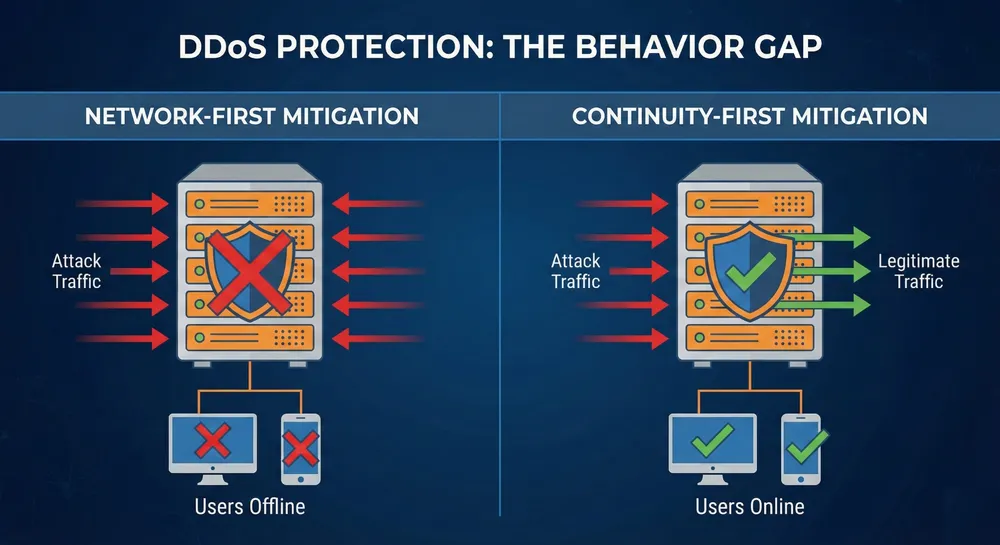
One keeps you online. One protects the network by dropping your traffic. Both can call it “protection”.
So stop asking whether a provider “has DDoS”. Start thinking about what the provider does when it happens.
The three outcomes you should understand
- Mitigation that keeps you online: attacks are scrubbed or filtered while legitimate traffic continues.
- Mitigation that protects the network first: the provider stays healthy, but your service may still degrade.
- Traffic is blackholed: everything to your IP is dropped. You are offline.
What Worldstream publishes about its approach
Worldstream describes DDoS protection as standard across its infrastructure, enhanced by Nokia Deepfield Defender, with published mitigation capacity figures. It also describes a standard anti-DDoS inclusion on dedicated servers and the option to scale it.
That is useful because it is specific. It sets expectations you can discuss.
If DDoS is part of your environment, this is where you should spend your attention. Not on CPU debates.
Support quality. What you want is ownership, not politeness
Most hosting content says “make sure support is good”.
That advice is true and useless.
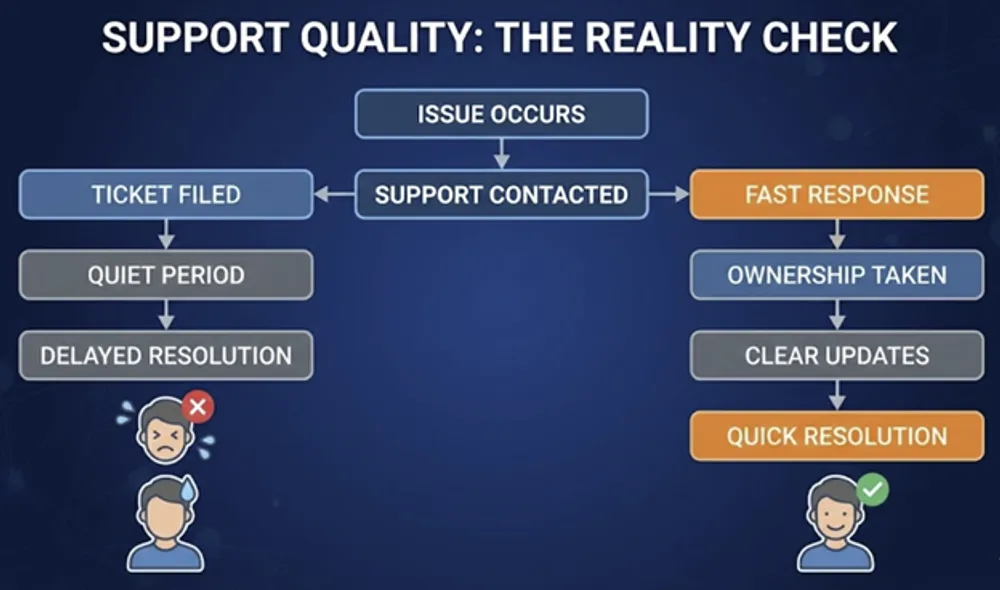
Support quality is simple:
- Do they answer fast.
- Do they take ownership.
- Do you get clear updates until resolution.
Anything else is decoration.
Why it matters more on dedicated servers
With many cloud setups, you can self-heal. You can rebuild an instance. You can redeploy from images.
With dedicated servers, you own the environment. When hardware fails or the network needs action, you need the provider. Fast.
What Worldstream publishes about support
Worldstream states 24/7/365 support across chat, phone and email, and it publishes an average response time figure of 7 minutes.
A response time number is not a guarantee of resolution time. But it is the right type of commitment. Measurable and operational.
Location in Europe. Choose it for users, not for flags
Many buyers start with geography. A specific country. A specific city. A specific label in a dropdown. Sometimes that is driven by policy. Often it is driven by user experience.
The real question is simpler.
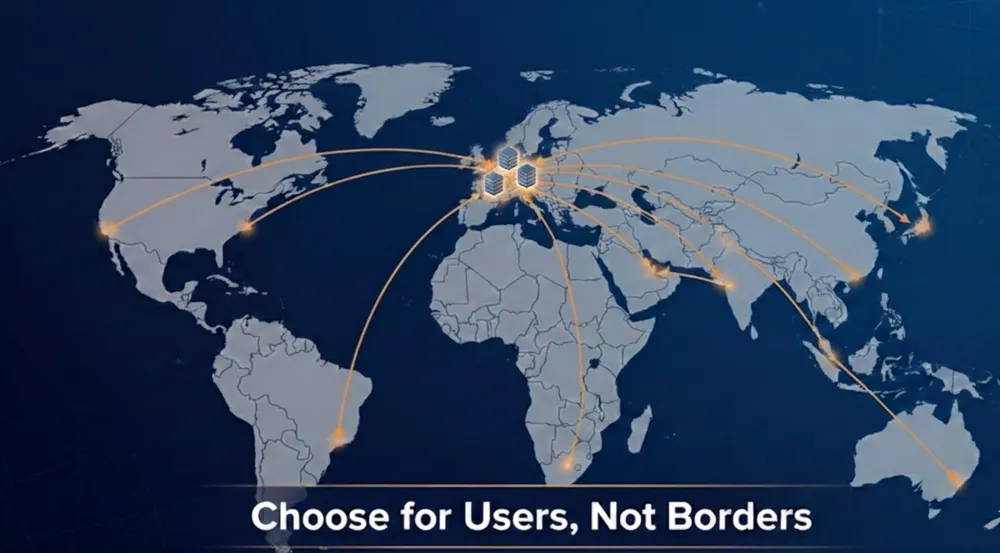
Where are your users. What latency do they tolerate. What routes are reliable to them.
Location is a network decision, not a branding decision. A good provider will talk about connectivity and outcomes, not only about postal codes.
Predictable pricing and clear agreements are part of reliability
Most buyers separate infrastructure from contracts. That is a mistake.
Bad agreements create operational instability:
- unclear cancellation terms
- surprise commitments
- vague “fair use” rules
- unexpected enforcement during incidents
- pricing that drifts without warning
When rules are fuzzy, every incident gets harder. Your team wastes time arguing about policy instead of solving the problem.
Worldstream’s public messaging leans toward predictable monthly pricing and straightforward service delivery.
The point is not the wording. The point is the operating principle. Clarity reduces risk.
The trap of cheap hardware deals
Cheap servers are not bad. Blindly cheap servers are.
If a deal is based on older hardware, it can still be fine. Especially for labs and non-critical workloads.
But two failure modes show up again and again.
1) You buy old hardware for a workload that needs consistent storage
IO-heavy workloads do not fail loudly. They fail slowly.
Checkout gets slower. Jobs pile up. Customers complain. Nobody can reproduce it in a clean benchmark. The infrastructure becomes a blame magnet.
2) You treat “cheap” as a substitute for resilience
A cheap server is not a backup plan.
If you run production, cost savings only make sense after you have:
- tested backups
- a restore path that works under pressure
- monitoring that detects issues early
- a plan for hardware failure
Otherwise you are not saving money. You are delaying the bill.
A simple way to compare providers that actually works
Everyone says they are reliable. Everyone says they have support. Everyone says they have DDoS protection.
So compare providers on operational reality.
Pick your non-negotiables
Choose two. Three at most.
Examples:
- continuity during attacks
- fast, competent support
- predictable monthly costs
- stable storage performance
- a specific location requirement
If everything is critical, you will pick based on feelings and price.
Decide what “good” means for each
Keep it concrete:
- DDoS: legitimate users stay reachable during typical attacks.
- Support: you can reach a human 24/7 and the ticket gets owned to resolution.
- Costs: the monthly bill is predictable and explainable.
Compare based on operations, not promises
This is where real differences show up.
Worldstream’s published posture is explicit on support availability and response speed, and explicit on DDoS approach and capacity.
That is the kind of infrastructure provider profile that reduces bad-day uncertainty.
Where Worldstream fits
Worldstream is a European infrastructure provider focused on dedicated servers, private cloud, and connectivity, operated and managed in-house.
If you are choosing in Europe and you care about support responsiveness, DDoS posture, and predictable operations, Worldstream belongs on the shortlist.
A short checklist that feels like real life
Pick the provider that makes the bad day predictable.
Ask yourself:
- If we get attacked, do we stay online.
- If hardware fails, do we get fast action and clear updates.
- If there is a billing or policy issue, do we get clarity or drama.
- If we need a specific location, can they deliver it without games.
That is what “a good dedicated server provider” means.
Not a CPU chart.
FAQs
Operational outcomes. DDoS behavior, support ownership, and predictable agreements affect uptime more than small spec differences.